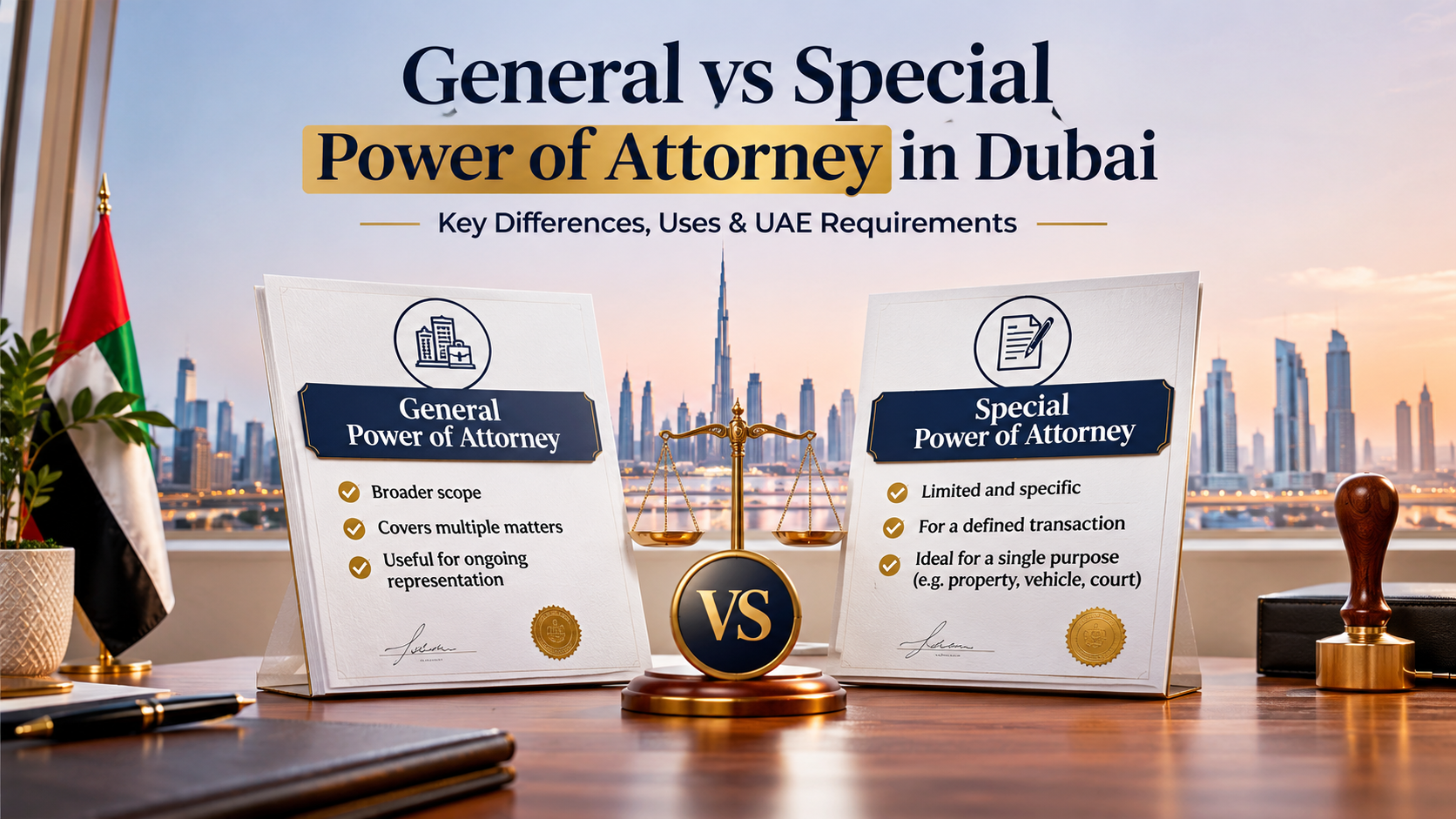
The main difference between a Power of Attorney and Special Power of Attorney is the scope of authority given to the representative. A General Power of Attorney can authorise a person to deal with several specified matters on the principal’s behalf, while a Special Power of Attorney is limited to a particular transaction, asset, proceeding or defined set of actions.
That distinction matters in Dubai because having a notarised POA does not automatically mean the representative can perform every transaction. The actual wording of the document, the powers granted and the requirements of the receiving authority, bank, court, developer or government department determine what the representative can do.
What Is a General Power of Attorney?
A General Power of Attorney gives an appointed representative authority to act for the principal across a broader range of matters stated in the document.
Depending on how it is drafted, these powers may cover areas such as:
- administrative matters;
- company or commercial affairs;
- certain banking matters;
- property management;
- signing and submitting documents;
- dealing with government departments;
- handling specified contracts; and
- representing the principal in other expressly authorised matters.
The word general should not be interpreted as unlimited authority. The representative can act only within the authority actually granted by the POA and subject to any additional legal or institutional requirements that apply to the transaction.
For example, a broadly drafted POA referring to property management does not necessarily authorise the representative to sell a particular property, mortgage it or receive sale proceeds. Those powers may need to be stated expressly.
Notary Public Dubai
Contact our Notary Public Dubai team for fast and reliable notary services in the UAE.
What Is a Special Power of Attorney?
A Special Power of Attorney, sometimes described as a limited or specific POA, gives the representative authority for a defined purpose.
Examples can include authority to:
- sell or purchase a specific property;
- transfer a particular vehicle;
- represent the principal in a specified court case;
- sign documents for a particular company transaction;
- deal with a defined bank matter;
- complete a particular government application; or
- carry out another clearly identified transaction.
Once the scope has been defined, the attorney should not act outside those powers.
If you need a document for a particular transaction, our detailed guide to a Special Power of Attorney in Dubai explains the drafting and notarisation considerations in more detail.
General Power of Attorney vs Special Power of Attorney
| Point | General Power of Attorney | Special Power of Attorney |
|---|---|---|
| Scope | Covers several specified areas or powers | Limited to a particular matter or transaction |
| Purpose | Useful where ongoing or broader representation is required | Useful where one defined task or transaction must be completed |
| Authority | Broader, but still limited by the wording of the document | Restricted to the powers expressly stated |
| Typical examples | Managing several business, administrative or personal matters | Selling a named property, transferring a vehicle or handling a specific case |
| Risk of overly broad authority | Generally higher if drafted too widely | Usually easier to restrict to the required task |
| Acceptance | Depends on wording and requirements of the receiving authority | Depends on wording and requirements of the receiving authority |
Is a Special Power of Attorney Safer Than a General POA?
A Special Power of Attorney can reduce the amount of authority being delegated because it limits the representative to identified actions. That can make it more suitable where the principal only needs someone to complete one transaction.
For example, if you only need another person to sell one vehicle, there may be little reason to give that person authority over unrelated property, company or banking matters.
However, a Special POA is not automatically the correct document in every case. If the representative genuinely needs to manage several ongoing matters, creating an extremely narrow POA may result in repeated amendments or new documents.
The better question is therefore not simply which POA is “safer”, but what powers does the representative genuinely need?
Does a General POA Allow the Attorney to Do Everything?
No. This is one of the most common misunderstandings about Powers of Attorney.
Even a General Power of Attorney must be interpreted according to the powers stated in the instrument and the law governing the particular transaction.
Some actions can require clear or specific authority. UAE legislation itself uses the concept of a Special Power of Attorney in particular procedures. For example, certain procedural acts under UAE evidence and mediation laws require representation under a special authority.
Receiving organisations can also impose their own documentary requirements. A bank may require specific banking powers. A property authority may require express authority concerning sale, mortgage or transfer. A company registrar may require wording dealing with a particular corporate act.
A general clause such as “to represent me in all matters” should therefore not be assumed to satisfy every authority or transaction.
When Is a Special Power of Attorney Usually More Appropriate?
A Special POA is generally worth considering where the task is clearly identifiable from the beginning.
Examples include:
- selling one identified property;
- completing a property purchase;
- transferring or selling a particular vehicle;
- representing someone in a defined legal proceeding;
- signing a particular agreement;
- dealing with one bank transaction;
- completing a specific share or company transaction; or
- authorising a representative for one government procedure.
The document should describe the transaction and the powers the attorney needs to complete it.
When Can a General Power of Attorney Be More Practical?
A General POA can be more practical where the representative must deal with several related matters over a period of time.
This may arise when a principal:
- lives outside the UAE;
- owns or manages several assets;
- needs someone to handle recurring administrative matters;
- requires representation across several business activities; or
- cannot personally attend multiple transactions.
Even in these situations, each authority should be drafted deliberately. A General POA does not need to contain every possible power simply because the representative will handle more than one matter.
Do Both General and Special POAs Need Notarisation?
For official use in Dubai, Powers of Attorney generally need to complete the appropriate notarial procedure before they can be relied upon for transactions requiring formal authority.
Federal Decree-Law No. 20 of 2022 regulates the UAE notary profession. The current federal notary framework specifically recognises both general and special Powers of Attorney as notarial instruments.
Notarisation can involve verifying the identity and legal capacity of the person granting authority, reviewing the document and completing the required signing and authentication procedure.
Depending on the applicant and transaction, eligible POAs may also be processed electronically through authorised notarial systems.
For the practical process, see our guide to notarising a Power of Attorney in Dubai.
What Information Should the POA Contain?
The exact content depends on the purpose, but a properly prepared POA should usually identify:
- the principal granting the authority;
- the appointed representative or attorney;
- the powers being granted;
- the transaction or assets concerned where relevant;
- any restrictions on the attorney’s authority;
- any relevant validity period; and
- supporting information required for the particular transaction.
Property, vehicle, company, banking and court-related POAs can require different supporting documents and different wording.
For assistance preparing the correct document, see our Power of Attorney services in Dubai.
Can a General or Special POA Be Notarised Online?
Many UAE notarial transactions can now be handled electronically, although eligibility depends on the document, parties and applicable service.
The UAE Ministry of Justice currently provides digital Power of Attorney services through which eligible applicants can use UAE Pass, submit the application electronically, complete payment and sign digitally.
Dubai also provides electronic notarial services through the appropriate Dubai Courts channels.
However, online processing should not be understood to mean that every POA can always be completed without further verification or attendance. The relevant notarial authority may require additional identification, supporting documents, virtual verification or personal attendance depending on the case.
Notarisation, Attestation, Authentication and Legalisation: What Is the Difference?
These terms are often used interchangeably, but they refer to different stages.
Notarisation
Notarisation is the formal notarial process applied to the POA itself. It can include verification of identity, capacity, authority, signature and the instrument being executed.
Attestation or Authentication
Attestation generally verifies the authenticity of official signatures or seals on a document. The UAE Ministry of Foreign Affairs describes its attestation service as certifying the authenticity of signatures and seals on documents issued inside or outside the UAE.
Legalisation
Legalisation usually refers to the wider chain required when a document issued in one country needs to be accepted officially in another country.
A POA signed abroad may therefore be notarised in the country of execution but still require further authentication or legalisation before it is ready for use in the UAE.
What If the Power of Attorney Was Issued Outside the UAE?
A foreign-issued POA follows a different route from one executed directly through a UAE notarial system.
Depending on the country of issue and the nature of the POA, the process may involve:
- signing before the competent foreign notary or legal authority;
- authentication by the relevant authority in the issuing country;
- UAE Embassy or Consulate attestation where applicable;
- UAE Ministry of Foreign Affairs attestation; and
- certified Arabic translation where required.
The exact chain should always be checked for the country concerned. MOFA currently distinguishes between personal and commercial Powers of Attorney for attestation purposes, and commercial-content POAs may be treated as commercial documents.
Which POA Should You Choose?
Start with the task rather than the title of the document.
If the representative only needs to complete one clearly defined transaction, a Special Power of Attorney may provide a more precise scope.
If the representative genuinely needs authority across several related matters, a General Power of Attorney may be more practical, provided the necessary powers are clearly drafted.
Before signing either document, check:
- exactly what the attorney can do;
- whether any powers are unnecessarily broad;
- whether the receiving authority requires special wording;
- whether supporting documents are required;
- whether the POA has an expiry or transaction-specific validity rule; and
- whether the document requires notarisation, translation or cross-border attestation.
If you already have an older document, it is also worth checking whether the Power of Attorney is still valid and acceptable before using it for a new transaction.
Frequently Asked Questions
Notary Public Dubai
Contact our Notary Public Dubai team for fast and reliable notary services in the UAE.
Conclusion
The difference between a General Power of Attorney and a Special Power of Attorney is primarily the scope of authority. A General POA can cover several specified matters, while a Special POA limits the representative to a defined transaction or purpose.
The right choice depends on what the representative actually needs to do. In either case, the powers should be clearly drafted and checked against the requirements of the authority or organisation that will receive the document.